Treat It Like a Normal Technology
Companion to “Where to Invest in AI”
A companion to "Where to Invest in AI," the first webinar in our series with Andrei. The full recording is below.
Andrei opened the session by asking me the one piece of advice I wish more PE-backed companies were taking seriously about AI. I've been building AI products at Jeavio since 2017, so I think he expected something grand.
The honest answer is deflating: treat it like a normal technology.
We've spent fifty or sixty years learning how to fold new technology into our products and our companies, and almost all of those lessons still apply. The mistake I see most often is treating AI as a special case that suspends the old rules. It doesn't. So this is the companion piece to that session. If you were there, this is the map to keep. If you weren't, start here.
1. The frontier is jagged, and it keeps moving
What "jagged" means
Ethan Mollick, who writes about this more clearly than most, calls it the jagged frontier. The idea: AI capability isn't a clean line you can draw between "good at this, bad at that." It's more like a coastline, all nooks and crannies. These models are remarkable at some tasks and surprisingly poor at others that look just as hard. They write production code with tools like Claude Code and Codex, then fumble a problem of similar complexity in a different domain.
Why that matters for your roadmap
The frontier also moves. Last November we got a wave of model releases, Claude Opus 4.5 and GPT-5.2 among them, and reasoning over long, multi-step problems took a visible step up. Work somebody had carefully engineered a few months earlier became trivial overnight. You can't lock a three-year roadmap to what the models can't do today. You have to keep testing the specific shape of your problem.
The question to put to your team: where have we actually tested what AI can do for our problem, versus assumed it?
2. Your software stopped being deterministic
Since the 1940s we've built software the deterministic way: same input, same output, write a test, trust the result. That's the ground every engineering team stands on.
LLMs broke it. They're probabilistic. Ask the same question twice and you can get two different answers. That's where hallucinations and the other strange behaviors come from, and it's the source of most "we tried AI and it didn't work" stories. The fix is to constrain the outputs with guardrails and evaluations, and to get the whole team comfortable with non-determinism. It isn't only an engineering skill. Your PMs, your QA people, and your support staff all have to develop the instinct.
3. Where the money should go
When a CEO asks me where to put their AI budget, I reach for a 2x2. I sketched this one live during the session, bad handwriting and all. It's a crude tool for a complex decision, but it's a good place to start.
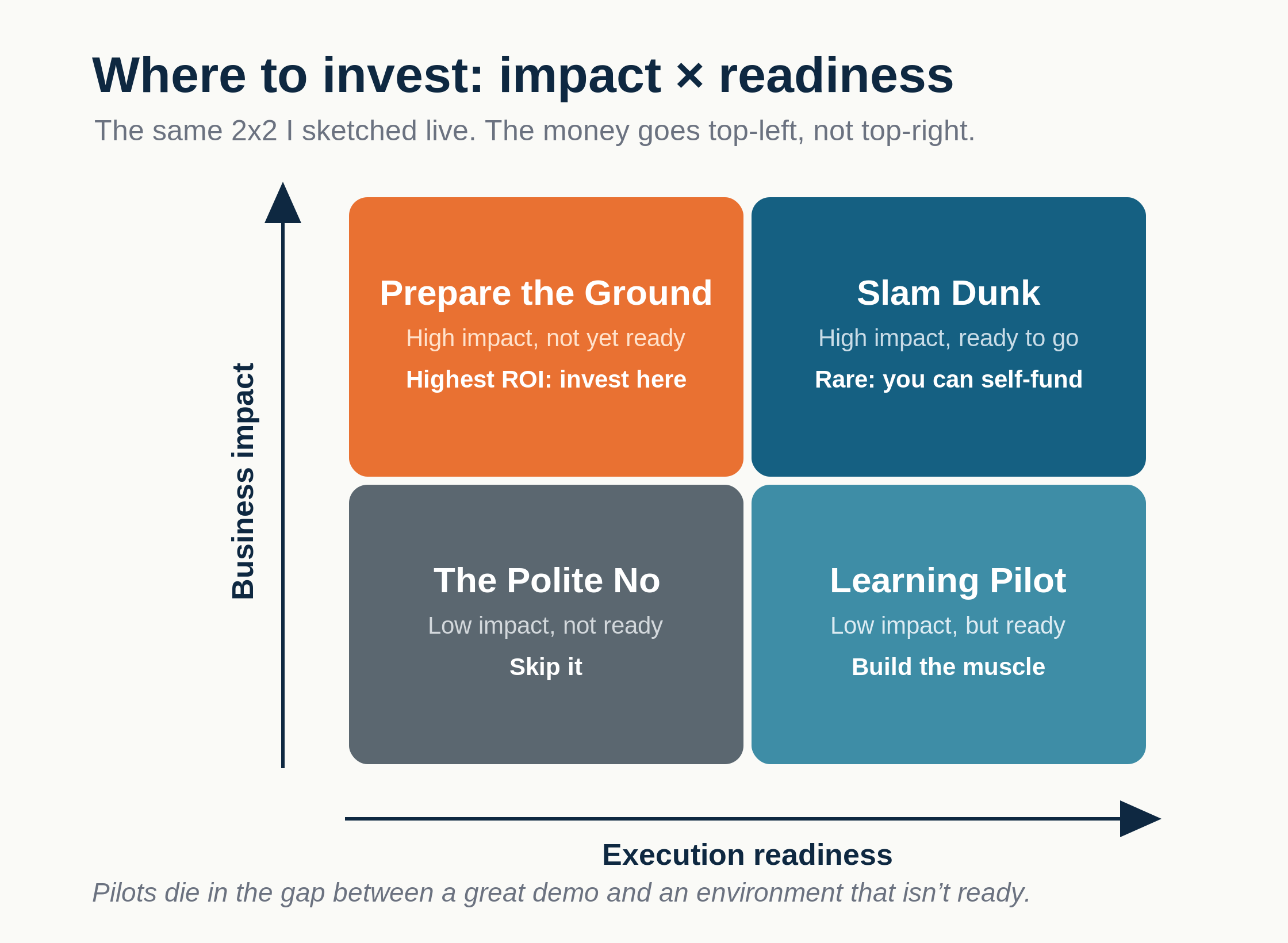
One axis is business impact: does this move a number the board cares about? The other is execution readiness: do you have the right data, the guardrails to judge the output, and a team that's ready for probabilistic systems?
The top-right corner, high impact and high readiness, is the slam dunk. It's also rare, and if you're sitting in it you don't need us. The quadrant that earns the highest return is the awkward one: high business impact, low execution readiness. I call it preparing the ground. Money spent there moves the project toward the corner where it can actually succeed.
This is why so many pilots demo beautifully and never reach production. The demo isn't the problem. The environment around it isn't ready, and you can't build a house on quicksand.
The question to put to your team: which quadrant are our three biggest AI bets honestly in?
4. Four things AI is actually good at
Across our client work, almost every use case lands in one of four buckets:
- Knowledge management: finding and synthesizing what the company already knows.
- Document processing: vision and language models reading messy, varied documents, well past old-school OCR.
- Conversational interfaces: the chatbots and copilots.
- Workflow automation: stitching the others together, often where agents finally earn their place.
I probably come across as someone who hates chatbots. I don't, but I think we badly over-invest in them. Chat is a hard interface to use well. It hands the burden of learning to the user, who stares at a box and wonders what to type. Most of the public frustration with AI comes from exactly this: trying to rebook a flight with a bot that wastes your time.
What we under-invest in is the unglamorous work: studying the messy human workflows where people actually get stuck, then bringing AI to bear there. It's harder and less tangible than shipping a chatbot. It's also where the real ROI lives.
The question to put to your team: is this a chatbot because the problem needs one, or because it's the easy thing to ship?
5. Why the mandate backfires
Boards set direction, and that's their job. But "become an AI-native company, use AI in everything" is a mandate that measures the wrong thing. Once a metric becomes a target it stops being a useful metric. People chase tokens burned and seats filled, not work that got better.
There's research worth knowing here. BCG's 10-20-70 split says roughly 10 percent of your AI investment should go to algorithms, 20 percent to technology and data, and 70 percent to people and process.
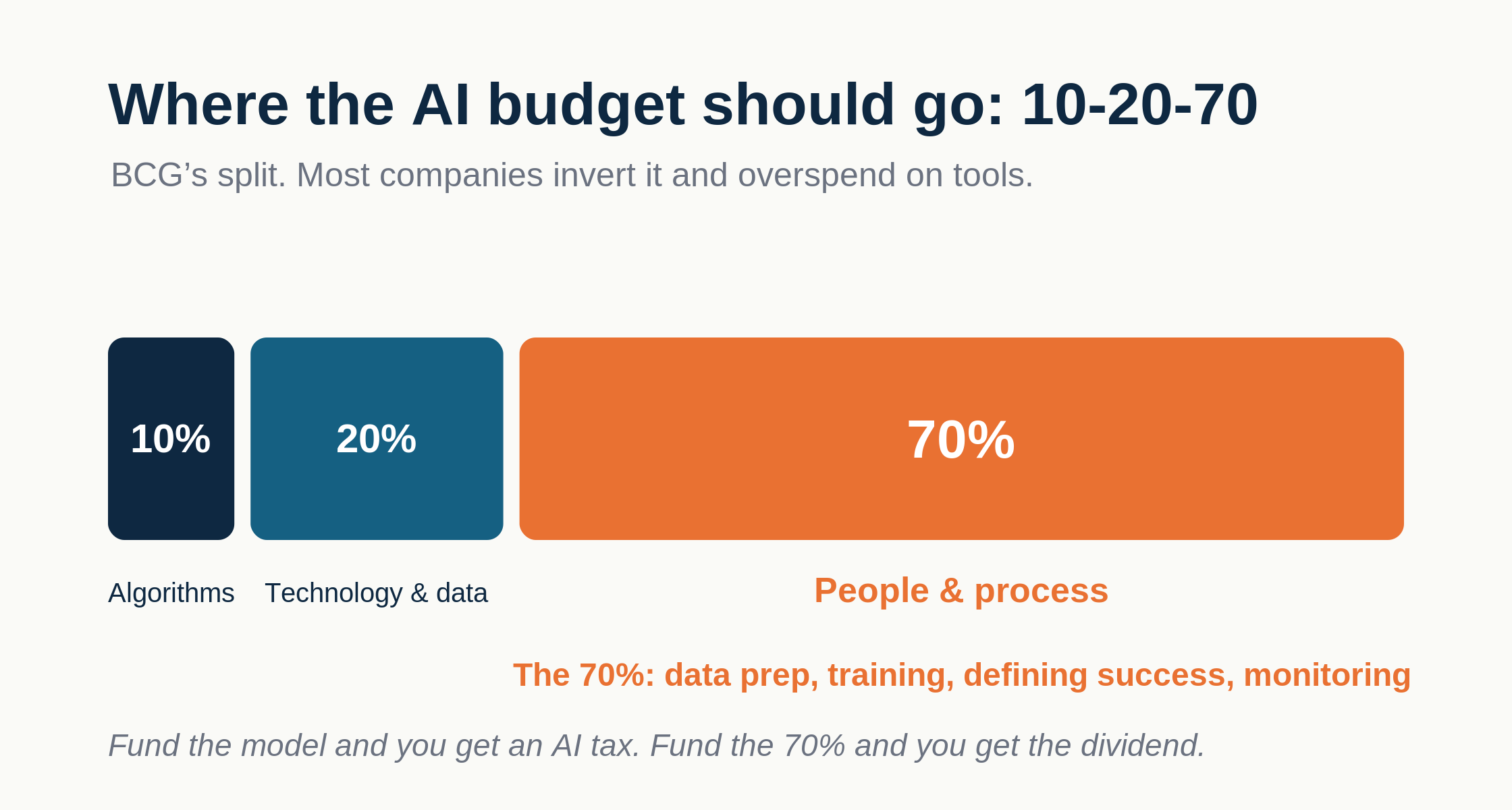
Most portfolio companies invert it. They spend 70 percent on tools and wonder why adoption stalls. The 70 percent is the part nobody photographs for the board deck: preparing your data, training your people, defining what success looks like, and building the measurement to know whether you got there.
What to do Monday
If you take three things from the session, these are the ones I closed on:
- Start small. One bottom-up pilot beats one big mandate. Jeavio's first real AI win was an intern project back in early 2023.
- Define success before you spend. Plot your initiatives on the 2x2 and be honest about the quadrant.
- Don't default to top-down mandates. Fund explorers instead: hackathons, volunteer teams, a budget for people to poke at the tools. The way to map a jagged frontier is to send out a lot of explorers.
Most AI investments don't fail because the technology is wrong. They fail because the 70 percent wasn't there. The good news: that's the part you can fix without waiting for the next model release.