Calamities at Various Timescales
A Roadtrip through the American Southwest
I hadn’t realized how close I was to burnout when I landed in Dallas last week. I was about to start a long-anticipated trip through the American Southwest, and I’d spent the flight doomscrolling X, reading about recursive self-improvement (AI systems that improve themselves) and wondering what AI would mean for my career and the careers of the people I support. What sort of education would my kids need, and what future awaited them?
I was traveling with Mehul, an old friend. We have known each other for almost 35 years, going back to high school in India, and we took this trip as a way of stepping back from our day-to-day lives. The plan was light. We would drive from Dallas up to Amarillo, then west on I-40 across New Mexico and into Arizona, and finish in Phoenix. Most of the stops we worked out along the way. Two Indian blokes in a rental car.
West from Amarillo #
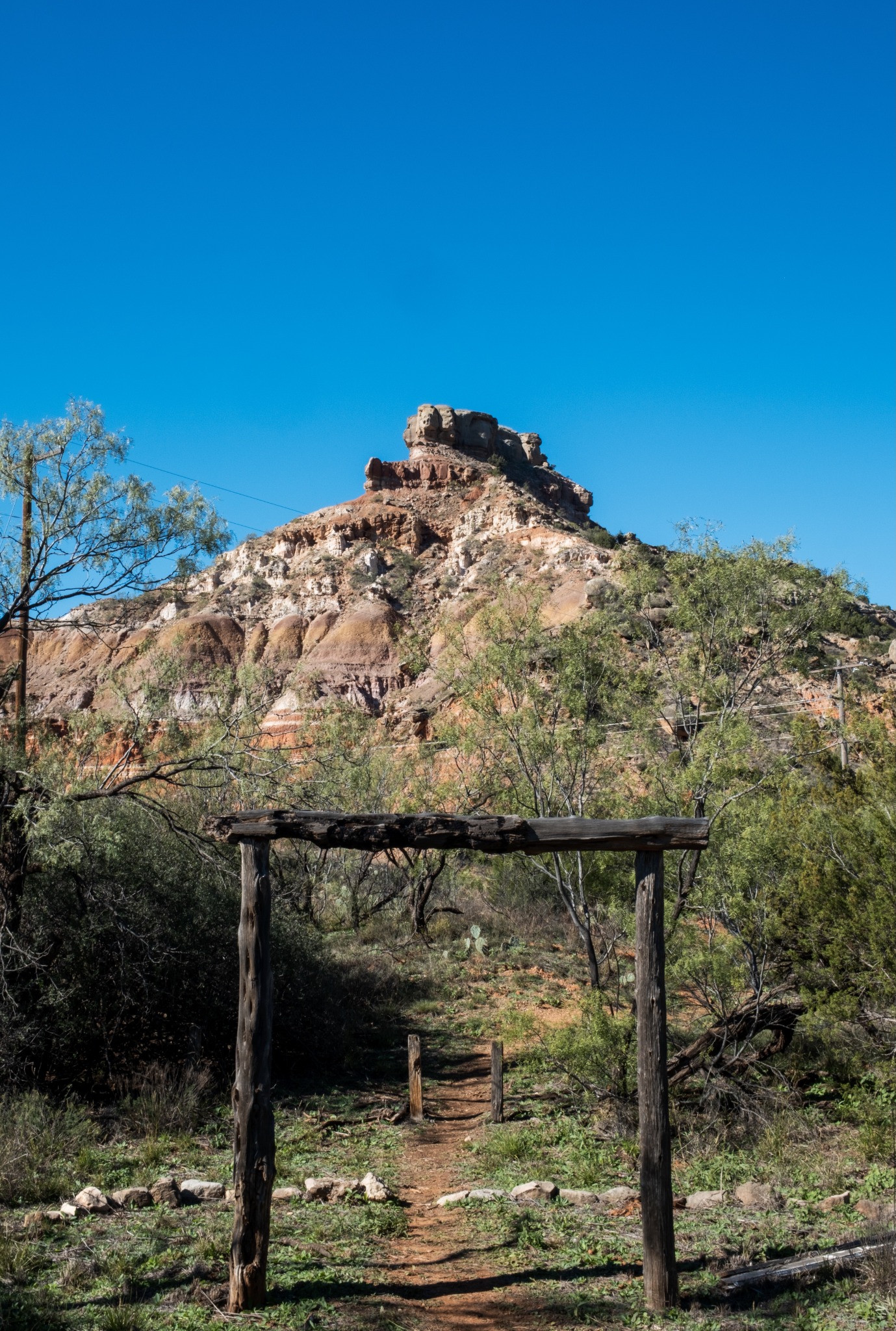
We started at Palo Duro Canyon, outside Amarillo. We walked between its red walls and read about how, almost a hundred years ago, the CCC (Civilian Conservation Corps) was engaged to build the state park as a way of generating employment in the depths of the Great Depression. Millions of people were out of work, and the government paid young men to build a park in a canyon. The pay was about a dollar a day, and “Another day, another dollar” was a running gag in the camps.
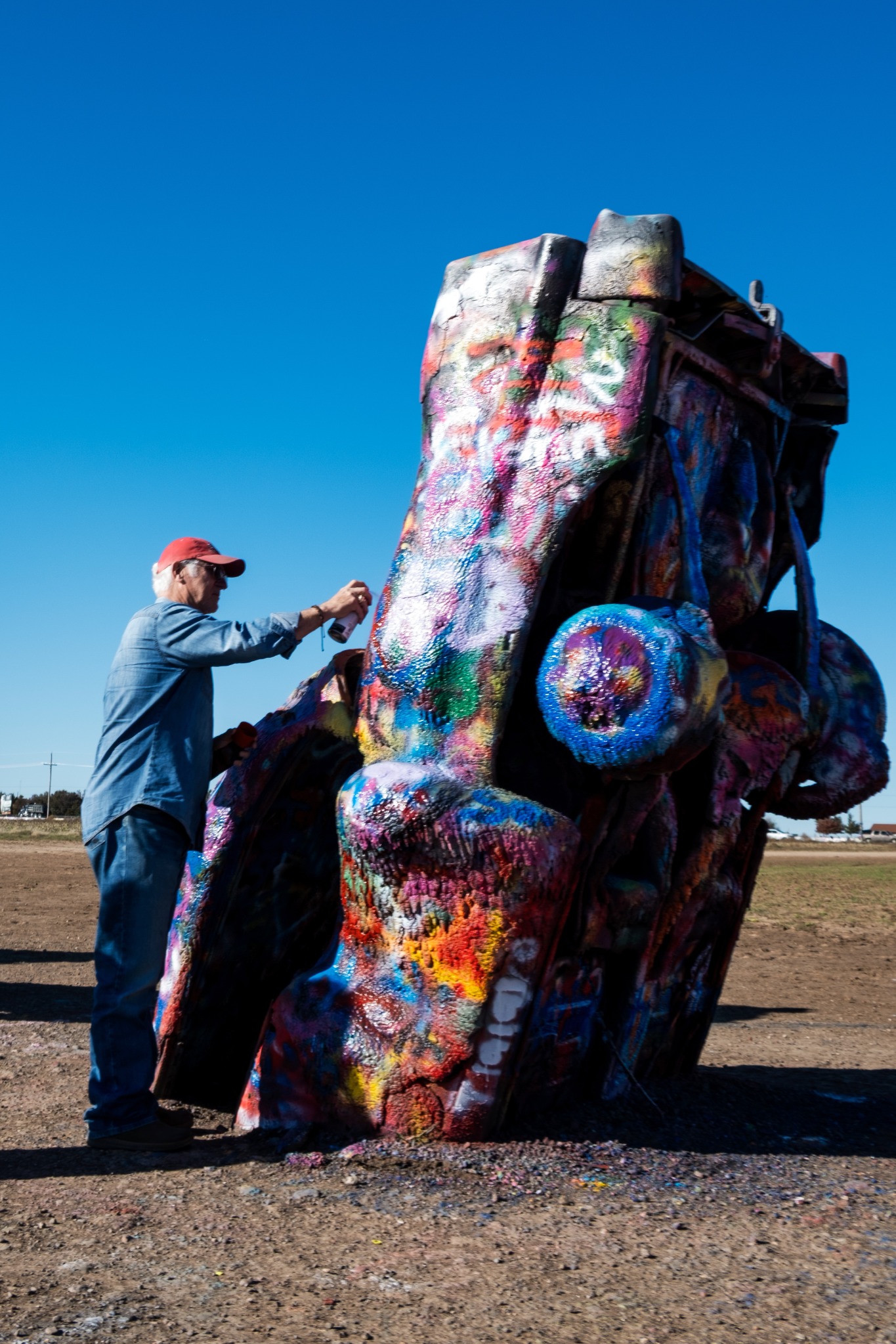
Before Tucumcari, we stopped at Cadillac Ranch. A line of ancient Cadillacs, tail fins and all, embedded in the oddly flat landscape outside Amarillo. Another stop, and a callback to the lost art of roadtripping. Families walked around with cans of paint, adding another layer of history. Eighteen-wheelers rolled past in the background as I tried to keep the sun to my back and take a picture.
As you drive west from Amarillo to Albuquerque, the land changes every hour. From ranches and scrubland to desert, to flat-topped mesas squatting at the horizon, as if waiting for something to happen. The sky is enormous. You lose perspective of altitude, distance, where the horizon is.
Giant windmills turn slowly, lined up along the ridges and facing into the wind, or standing solemnly alongside the interstate as trucks trundle past, taking goods to where people live. Texas generates more wind power than any other state. Beneath the same plains lie the gas fields of the Panhandle, in rock as old as the red walls of Palo Duro. Texas is also building data centers for AI as fast as it can, and much of the new power for them will come from burning that gas. Windmills on the mesas and gas from ancient rock are both feeding a very modern revolution.
For long stretches the railroad runs parallel to I-40, two tracks stretching across the landscape. The trains, with their orange BNSF locomotives, seem to go on forever. I couldn’t fit a whole train in my peripheral vision, even as it curved around the grassland. The logos on the containers, Amazon Prime and a parade of inscrutable logistics companies, are the heartbeat of the modern American economy. The eighteen-wheelers rule supreme on the interstate. Walmart, Amazon, Target. Many of them carry signs about open jobs. Hiring. Long-haul truckers wanted. Who knows how long for, now that driverless trucks are running on Texas highways.
Often the only signs of life along the interstate are gas stations with expensive diesel and the promise of clean restrooms or fried chicken (both if you are lucky). The billboards change too, advertising legal cannabis as you approach the New Mexico border and sometimes warning that fentanyl can be lethal. Life is a fine shade of gray.
We drove past little towns and wondered: what do people do here? What is there to do in this empty landscape?
Ghosts of Route 66 #
I-40 follows the old Route 66, and we saw ghosts of that old road all along the way. Electric and telephone poles with no cables, following a road that is no longer there. Faded billboards for roadside attractions that became less attractive as cars became more comfortable and adaptive cruise control became standard.
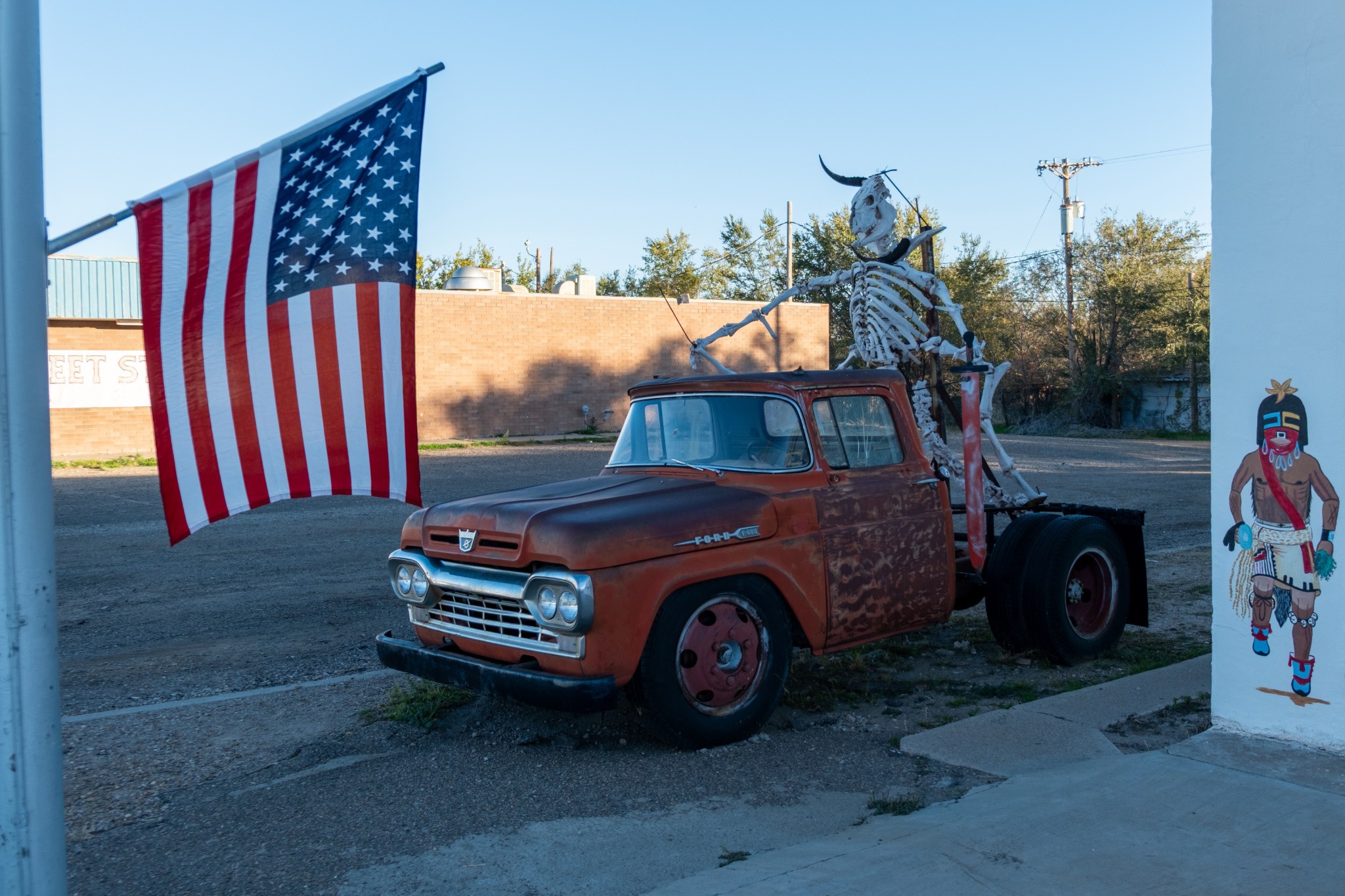
From Route 66, Tucumcari, New Mexico, looks like a ghost town, or maybe a zombie town. Boarded-up motels, hollowed-out businesses, fading neon signs still promising a good time. The traffic moved to the interstate decades ago. The only establishments still going are for tourists like us, searching for a part of the old Americana: a coffee shop that leans into kitsch, a souvenir shop with a large “Indian” mural outside it, and a red truck with the skeleton of a cow piled in the back. It looked like the classic Hallmark red truck, the one that carries a Christmas tree on greeting cards, except with bones. A fuck you to the America that left towns like Tucumcari behind.
I bought magnets and stickers, and we got back on I-40.
Into Albuquerque #
As we drove into New Mexico, signs offering “Indian crafts and curios” became more common and the landscape became more striated. Mesas and mountains, red, gray and brown, loomed to the west and to the north as I-40 continued its relentless advance toward the Pacific. Every few minutes we would stare slack-jawed out to the horizon. Look at the sky. Look at those hills. Unlike anything we had seen before.
We wondered what it would be like to live up in the New Mexican desert, and we kept circling back to the same question: what would we do in this empty landscape?
As night fell we first climbed and then descended into Albuquerque. I drove half-blind through the sunset and the twisting canyons into the giant bowl where the city sits like a glittering jewel in the gloaming.
We talked about walking to the cocktail bar near our hotel, but ended up driving another 20 minutes to an Indian restaurant called Naan and Dosa and ordering way too much food. The other kind of Indian. You can take the men out of India, but some habits are hard to break.
Trees turned to stone #
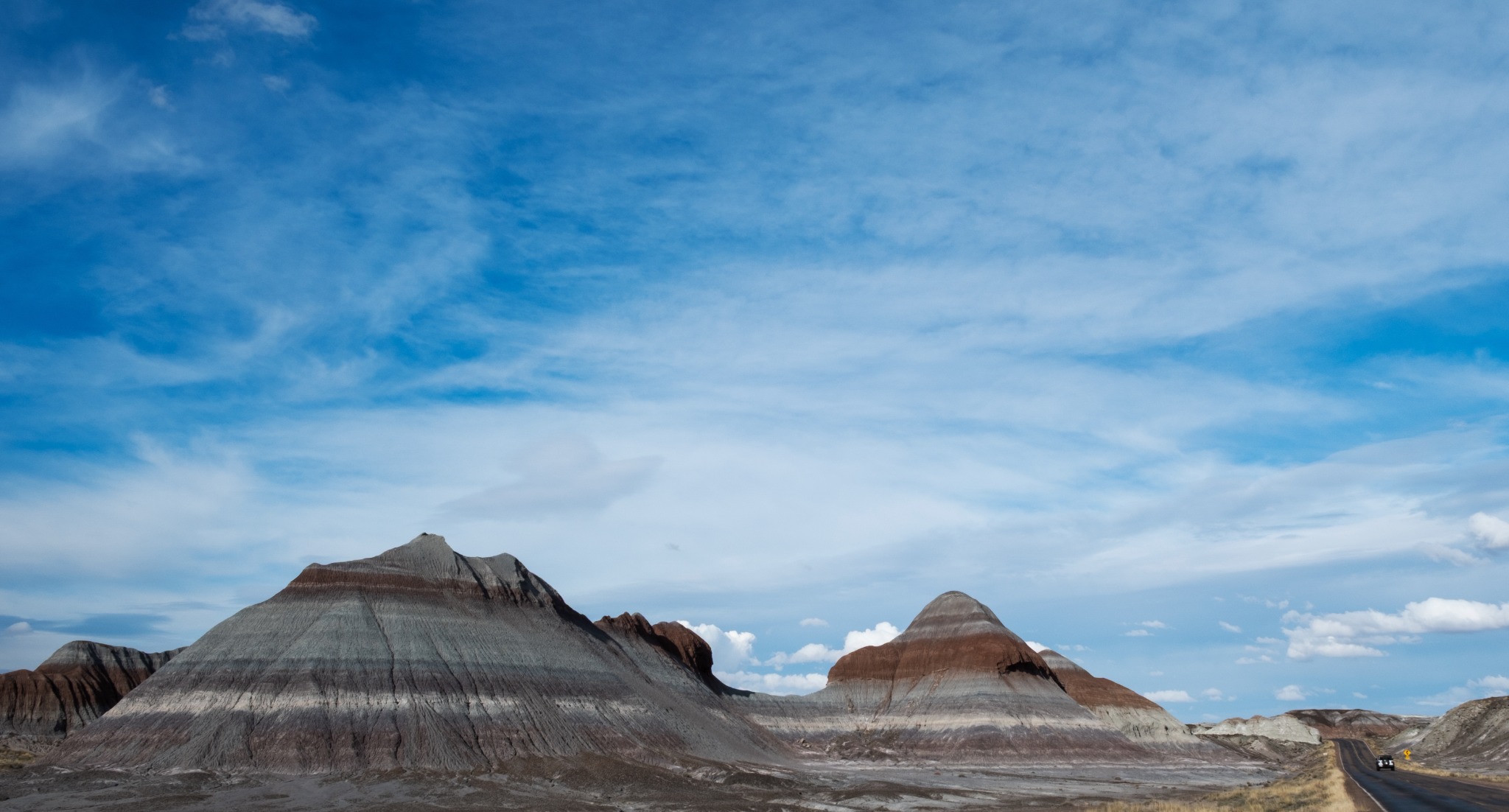
On Friday I woke up feeling bloated, thanks to too much Indian food, and we hit the road further west, toward Arizona and the Painted Desert. At Petrified Forest National Park, the colors and striations of the soil mark epochs and eons of time. Geologic upheaval, moving tectonic plates, the uplift of the Colorado Plateau, all measured in increments of time that I cannot fathom.
We walked in a loop around petrified trees and tried to imagine this dry and alien landscape as a dense forest with giant trees and winding rivers. A tropical paradise in the Triassic, more than 200 million years ago, when the continents were joined in Pangaea. I took photos of the logs, trying to catch the sun sparkling in the crystals. The forest was already stone by the time T. rex stomped on these grounds. Again the passage of time confounds me.
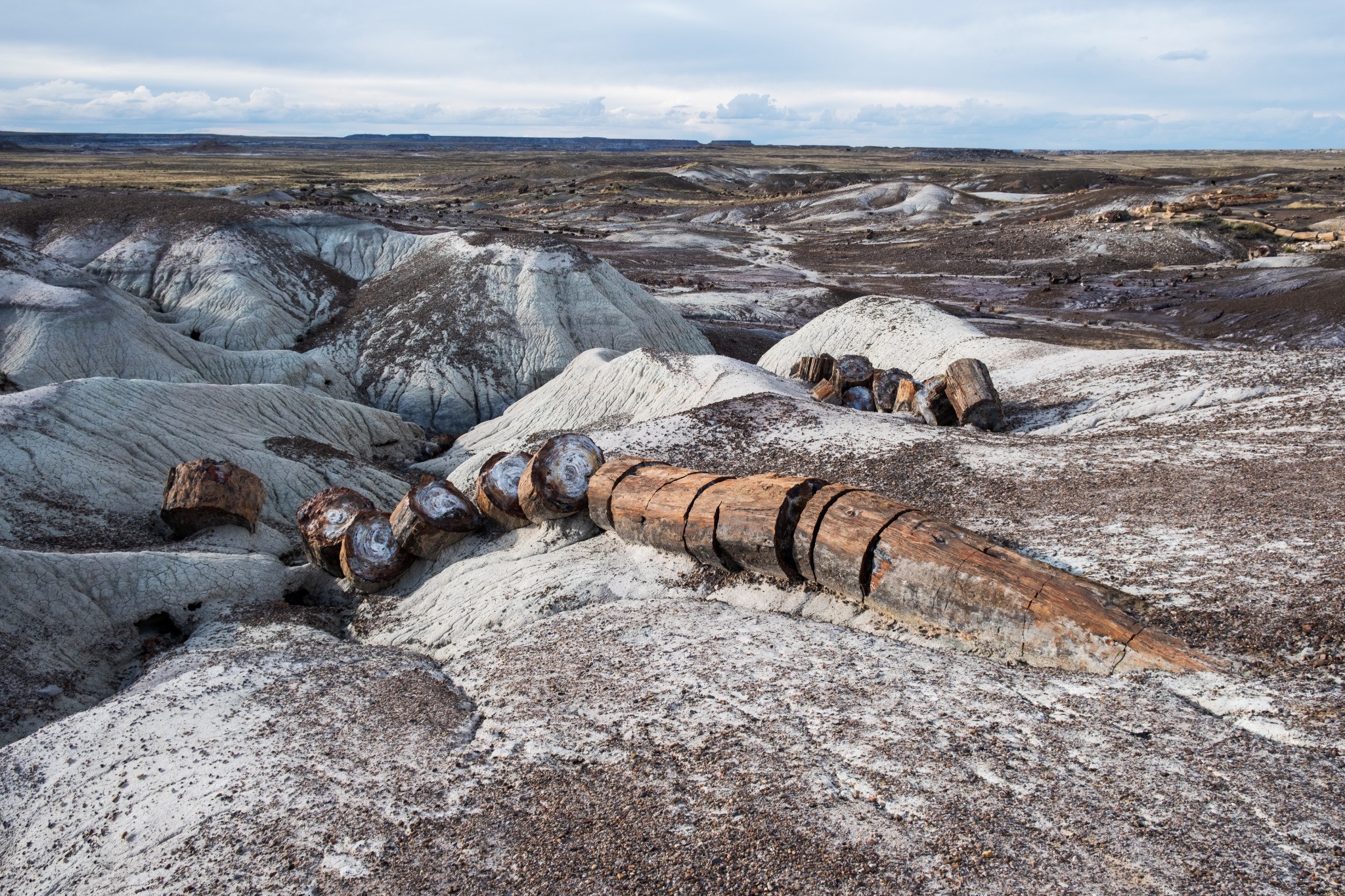
As we walked, we talked about the news buzzing on our phones: a Microsoft outage, and a ground stop called by the FAA (Federal Aviation Administration). We were looking at a landscape shaped by relentless and slow-moving forces and hoping for some perspective.
Twin Arrows #
We had not planned on a casino. But you can see Twin Arrows from I-40, standing out in an otherwise empty landscape west of Winslow, another interstate town lined with gas stations and fast food restaurants. It is an imposing building with signs in the Navajo language, and that evening we pulled into the car park.
Inside was a large, relatively quiet space filled to the brim with slot machines. Big, small, animated, curved and blinking, their buttons and signs incomprehensible, promising thousands of dollars. We signed up for the casino card, and a patient woman at the desk explained how we could claim the new member bonus. We spent and lost $10 on a slot machine that blinked at us with some urgency, drawing lines around the symbols and adding and removing credits at random.
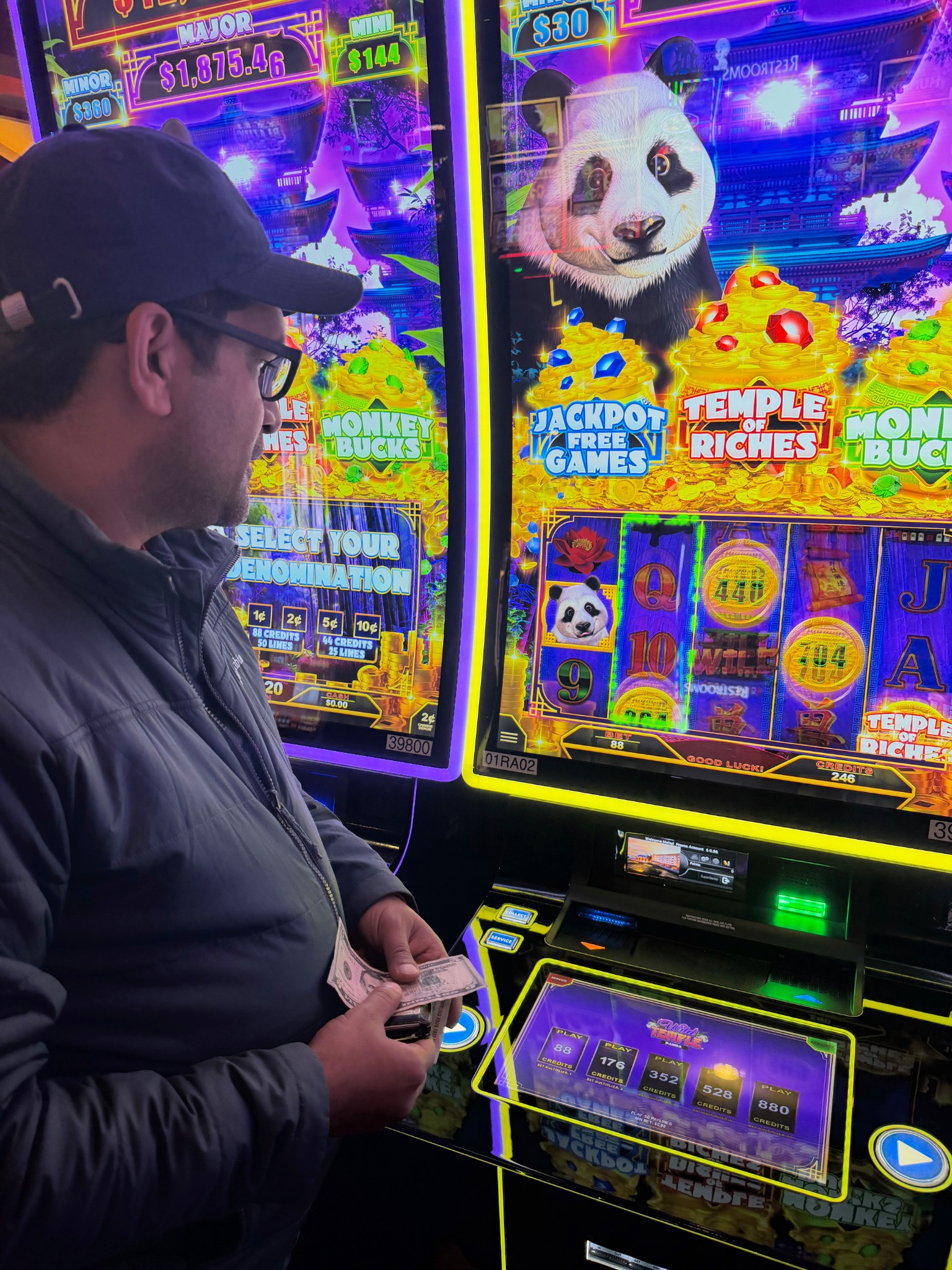
At least I had an answer to what people do around here. Some of them sit in front of slot machines pressing buttons. For ten dollars, so did we. It was sad to see so many people sitting passive in front of blinking screens. A future that might be coming for us all.
At the beverage station we met a woman who asked if we had been lucky. She had won $800 that evening, and she asked us, semi-seriously, whether we intended to rob her. When we told her we were a couple of Indian blokes on a road trip, she laughed. In relief, I think. We went on to the roulette table and lost $20 in the blink of an eye.
Suitably chastened, we retreated to the restaurant to drink beer and eat chips with salsa, and looked at Google Maps to see how many casinos there were in the area. Quite a few, it turns out. I was asleep by 10 p.m. Not the most glamorous end to my night at the casino.
Ten seconds, a thousand years #
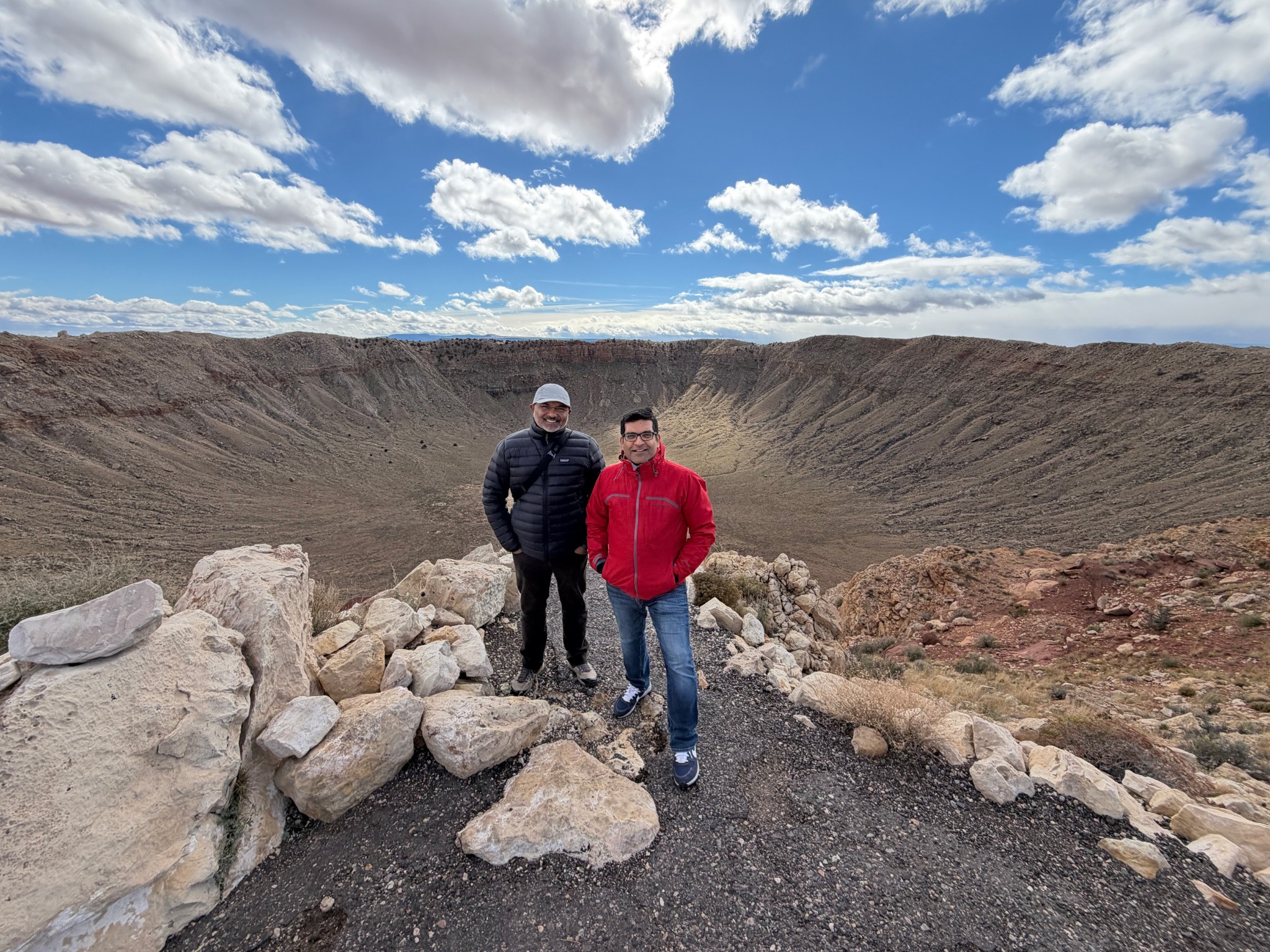
Saturday started with a rainbow through the window of our room. We stopped on a whim at Meteor Crater, an attraction I can only describe as keen. We heard about how the Apollo astronauts trained there, and at the gusty lip of the crater our enthusiastic guide described the argument between geologists over whether a volcano or a meteor made the hole. Team meteor prevailed, and they have the educational videos to show it. The meteor hit about 50,000 years ago and made the crater in about ten seconds. Erosion is slowly filling it in, and our guide said it will probably disappear in about 90,000 years. Time is a harsh mistress.
After warming up with some coffee and souvenir shopping, we decided to explore the mountains at the horizon and ended up at Sunset Crater, a cinder cone volcano formed about a thousand years ago. A geological baby! As we wandered around the lava flows, we read about the people who lived here and had to evacuate when the mountain blew its top. They had enough time to grab even the supporting beams of their houses. I guess one can be very motivated when facing impending doom in the form of a river of lava.
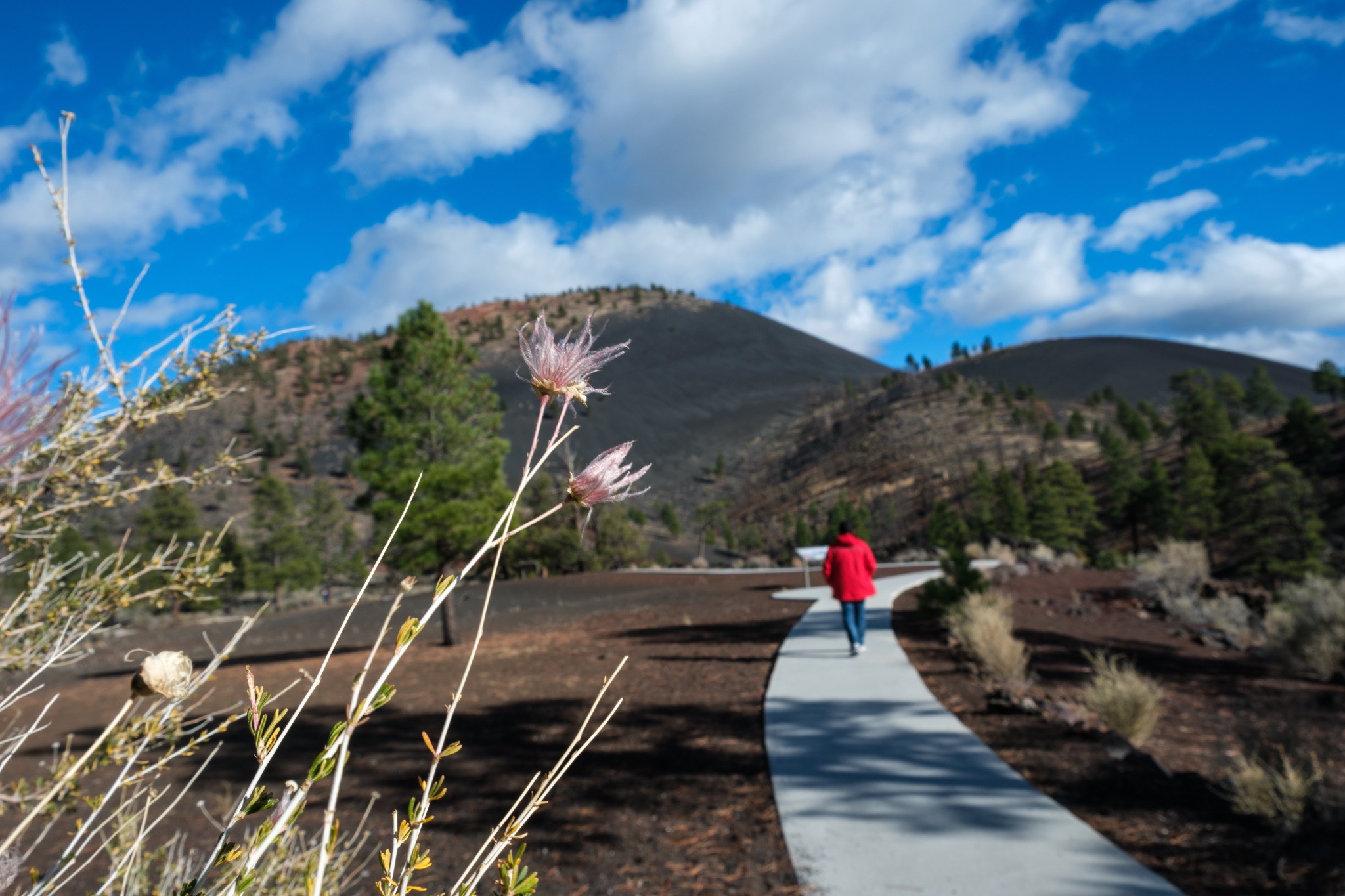
From the lookouts we admired the Painted Desert at a distance and the burnt-out husks of trees, the result of a much more recent calamity, a forest fire. Most of our day was spent admiring the results of calamities that happened over various timescales.
A giant ancient hole #
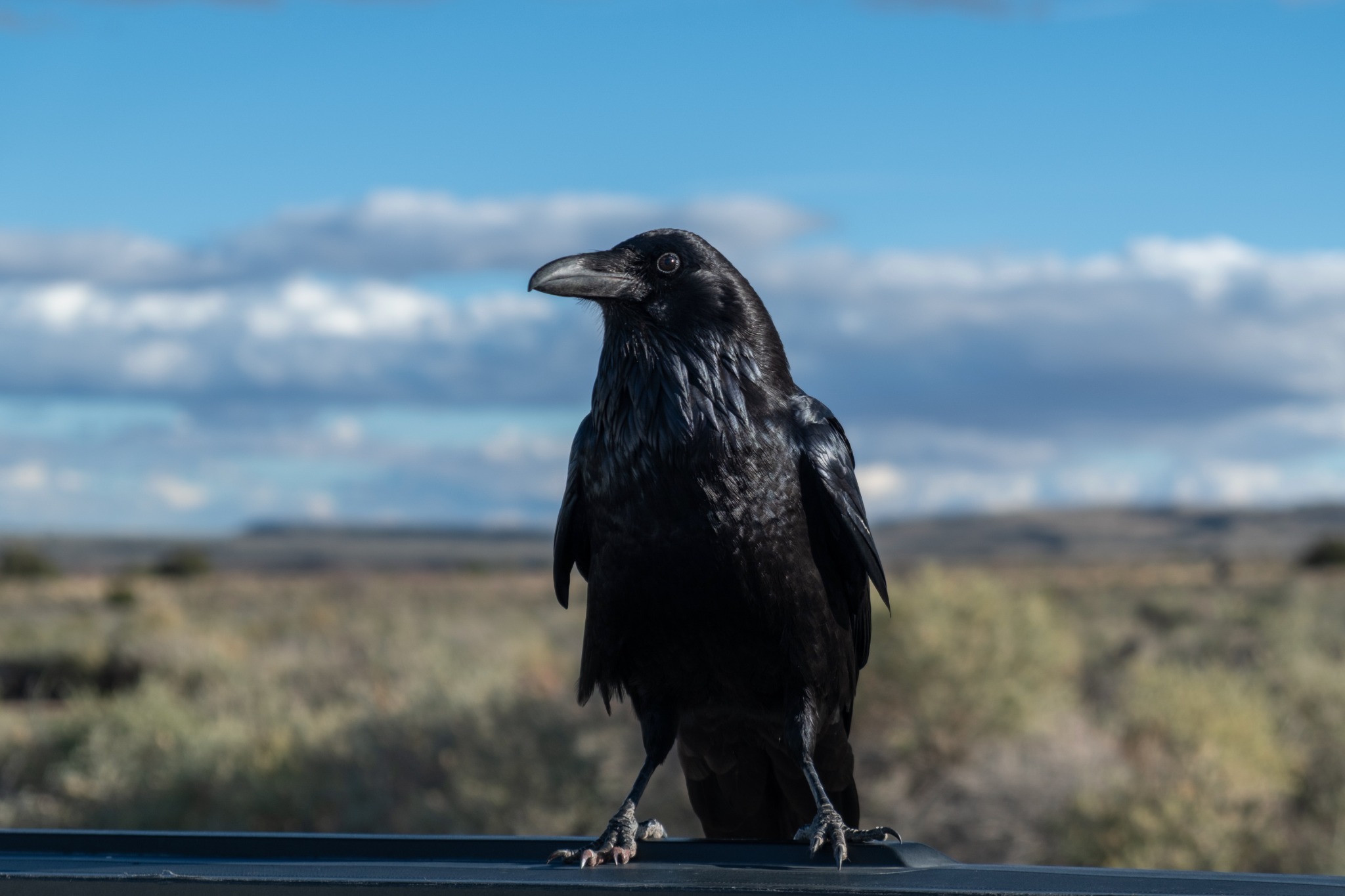
We emerged the next morning to a cold snap. The car gleamed under a layer of frost and the sky was clear and promising. I nodded at the ravens, which had been with us since New Mexico, and off we drove along State Route 64. The road was empty. It was a cold weekend morning, perhaps more suited to sipping a warm drink in pajamas than looking at a giant ancient hole. But the Grand Canyon was the last stop on our trip, and, suitably fortified after a ruinously expensive hotel breakfast, we were ready to see a wonder of the world.
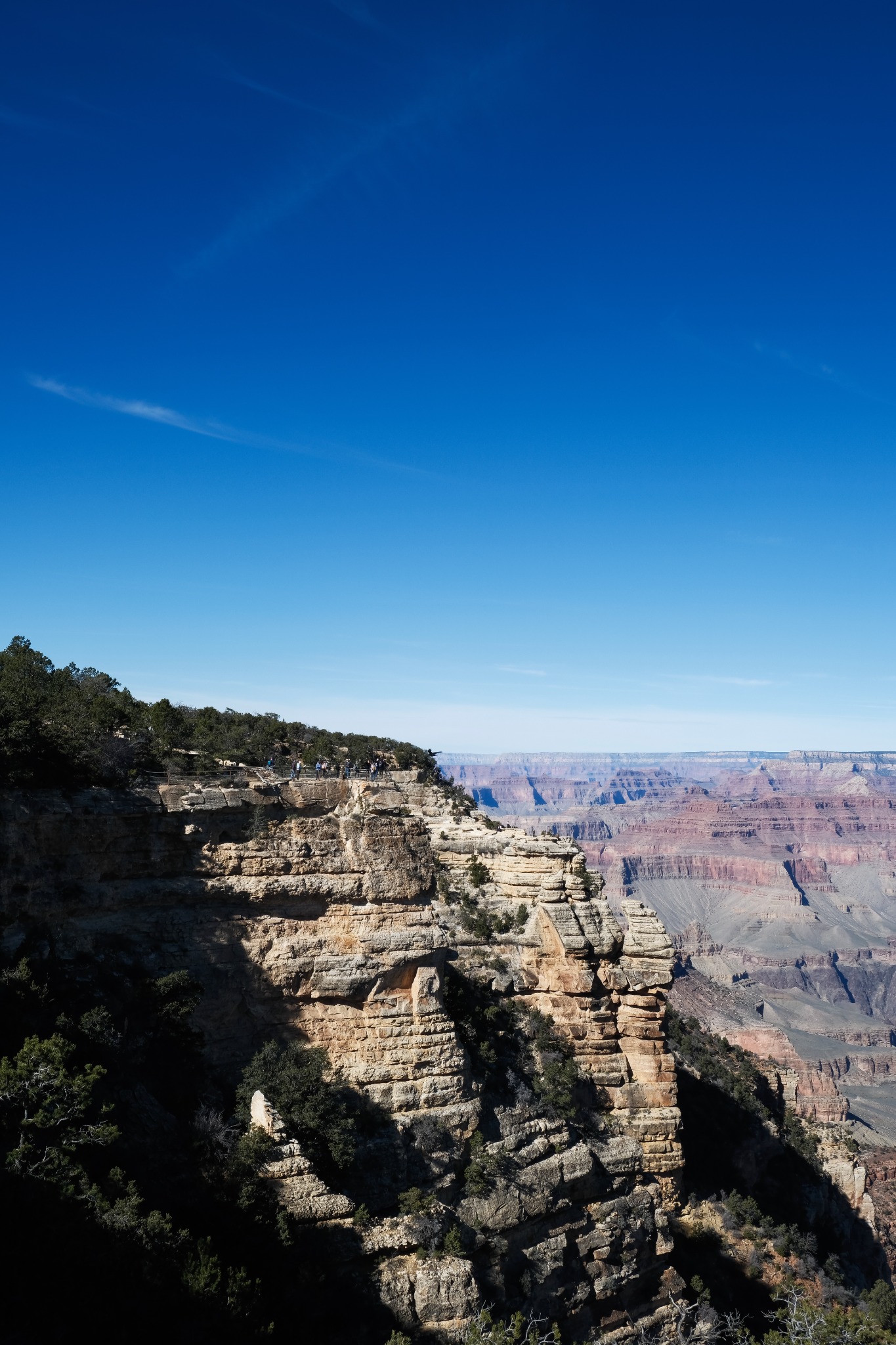
We stopped to stare at the sheer scale of the place. Jagged cliffs that started pale, turned red and then disappeared into the heart of the earth. This is what millions of years of slow erosion can do. Photographs don’t do justice to it, but I tried anyway, chasing the late morning light as it made its way into the canyon. We walked along the southern rim, reading signs about forest fires, geological phenomena and water shortages. I wondered what the first person to come upon this place must have thought. Perhaps a portal to another dimension? Perhaps a gateway to Tartarus?
We bought commemorative magnets and bookmarks and hit the road again, south this time.
Downhill to Sedona #
The highway descends steeply from the Colorado Plateau to the Arizona desert. Near Oak Creek we stopped to refuel both the car and our bellies, and over a lunch of fried Nashville hot chicken we found a hotel in Phoenix to complete our journey. On the way back to the highway we took pictures of the deep red landscape and saw faces eroded into the rock that looks over Sedona. Mehul read out some facts about the cost of living there, and how the median age of a resident is over 60. That explained the proliferation of healing crystal shops. So here was another answer. In Sedona, they retire.
I had been asking the question for days. What do people do in Tucumcari, now that the traffic has gone? What do they do in the little towns along the interstate? It is the question I carried onto the plane to Dallas, asked about other people. What will I do? Retirement is the answer for people who finished their careers before AI arrived. I have not. My girls have not even started.
The people at Sunset Crater had time to carry out their roof beams. Meteor Crater took ten seconds. I don’t know which kind of calamity this is. The irony is that I am not running anywhere with my valuables. I spend my working days helping engineering teams adopt AI.
The pine trees near Flagstaff gave way to tall cacti, and the road broadened as we rolled into Phoenix. As we pulled into the final highway hotel of our trip, my thoughts turned to early calls and a short layover between my flights.
I fly back today, and my AI agent, Claude, is already pinging me about Slack messages that need my attention and calls I need to prepare for.